
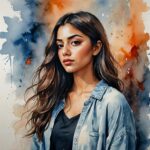

The harsh flash, without the harsh camera.
You, upload a regular photo. Out comes a direct-flash version – harsh light on your face, blown-out highlights, deep background shadow, a touch of grain.
No flash. No camera. One upload.
The look started in Instagram Stories – a filter that turned any photo into a paparazzi-flash frame, then bled into Reels, TikTok, and feed posts. Creator @marybautistayt posted one of the early ones, and the trend ran from Stories into everything else. The IG filter is gone now, but the look isn’t. The same one-tap effect is live on Gen.Ai.
What is the AI Flash Filter trend?
A photo edit that takes a soft, ambient-light image and rebuilds it as a direct-flash shot – the kind of frame that looks like a phone-camera flash fired two feet from your face.
The signatures:
- Hard, frontal light on the subject
- Blown-out skin highlights, sharp shadow falloff
- Background goes near-black or dim
- Light film grain, slight cool cast
- 2010s digi-cam, paparazzi, club-photo energy
It’s a one-tap effect on Gen.Ai. Upload a photo. Generate. Post.
Why it’s hitting right now
- It broke out of Stories. Started as an Instagram Stories filter, then jumped to Reels, TikTok, and grid posts. Once a Story trend escapes Stories, it’s everywhere within a week.
- 2010s flash nostalgia is the look. Digital camera grain, party-flash aesthetic, blurry-but-cool frames. Gen Z is mining it for everything.
- Soft-light fatigue. Ring-light selfies and golden-hour content are oversaturated. Hard flash reads as raw and intentional.
- One tap, no prompt. No lighting setup, no editing pass. Upload, generate, done.
- It works on photos you already have. Old selfies, group shots, mirror pics – the flash makes them all read as a single aesthetic.
Photos that make the flash land
The effect rebuilds the lighting. The source photo decides whether the result reads as a real flash frame or an obvious filter.
- Shoulders-up portrait, eyes to camera – the flash hits cleanest
- Mirror selfie, phone visible – reads as a real digi-cam moment
- Group shot at a table or bar – the night-out energy is built in
- Outfit detail in frame – jewelry, sequins, leather, gloss all catch the flash
- Indoor or low-light source photo – the dim background converts more believably
- Slightly off-center pose – candid framing sells the “caught on camera” vibe
Skip: bright outdoor photos with no shadow, photos where the subject is small in frame, anything with heavy filter already applied.
How to get the AI Flash Filter look on Gen.Ai
Step 1: Open the effect
Go to the AI Flash Filter on Gen.Ai.
Step 2: Upload your photo
JPEG, PNG, or WEBP. Indoor or low-light shots convert best.
Step 3: Generate
Tap Generate. The effect rebuilds the photo with direct-flash lighting, blown highlights, and a darkened background in one pass.
Step 4: Download and post
Save the file. Post to Stories first – that’s where the trend lives – then carry it over to Reels, TikTok, Shorts, or feed. The flash look is most at home in a carousel or Story set – flash frames hit harder in a sequence.
Pro tips for the look
- Run it on a set, not a single photo. Three or four flash-converted photos in a carousel reads as a roll, not a one-off.
- Mix in one real frame. A non-flash shot in the middle of the carousel breaks the rhythm and makes the flashes land harder.
- Lean into the dark background. Don’t crop tighter to fix it. The background falloff is half the look.
- Re-generate the same photo twice. Small variations in flash intensity and grain – pick the one that sells the night-out energy.
- Caption is the bit. Treat it like a found photo. “Pulled from the camera roll.” “2014 energy.” “No flash photography, please.”
One photo. One tap. Flash on.
Upload. Generate. Post.
The AI Flash Filter on Gen.Ai rebuilds the lighting, blows the highlights, drops the background, and adds the grain – in a single pass.
Pick a photo from the camera roll. Run the effect. Post the roll.


