

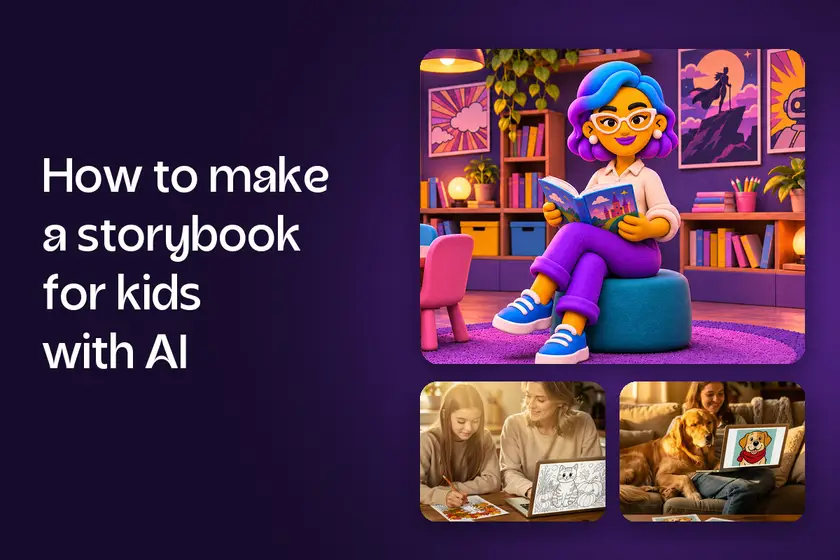
To make a storybook for kids, pick one reader, give one character a problem to solve, plan the story page by page, then illustrate it and print it. That’s the whole craft in one line. Each part matters more than it looks. A story for a four-year-old reads nothing like one for a ten-year-old. And a hero whose face changes between pages breaks the spell fast.
The hard part is the middle: writing, drawing and laying out pages that stay consistent. Tomi, the AI comic and storybook creator in Picsart, takes on that part. You bring an idea and say who the book is for. Tomi writes the story, keeps the characters the same and saves a print-ready PDF.
This guide covers what makes a storybook work and how to make a storybook step by step. It also shares ideas for home and the classroom, plus how to keep a story going.
What makes a good storybook for kids
Every children’s book that gets read twice gets three things right: the reader, the want and the rhythm. Miss one, and even great pictures won’t hold attention for long.
The reader comes first. Age decides how many words go on a page and how long the sentences run. Toddler books use repetition, bold shapes and one short line per page. Early readers need sentences they can sound out. Older kids want dialogue, chapters and a twist they didn’t see coming.
The want drives the story. “A day in the forest” is a setting. “A small fox who wants to sleep, but the forest won’t stop making noise” is a story. There’s a problem to solve. One character, one goal and one obstacle give a young reader a reason to turn the page.
The rhythm lives in the page turns. Good picture books end a page on a small question that the next page answers. A repeated line or three tries at the same task gives kids something to predict. Guessing what comes next is half the fun of being read to.
These six steps work for any storybook for kids, made by hand or with Tomi.
How to make a storybook step by step
1. Decide who the book is for
Name the reader before you write a line. A three-year-old, a seven-year-old learning to read and a class of second graders need three different books, even from the same idea. Tomi asks for this first. Pick the reader's age band, from 0 to 3 up to teens, and the words and pictures are made to fit.
2. Pick the format
Three formats work well for young readers. A picture tale has painted pages with the story set on paper below, like a classic picture book, and it's great for reading aloud. A comic has paneled pages with captions and lettered speech balloons, which suits kids who love dialogue. A coloring book has bold line art on white, with one scene and a line of story per page, so the reader finishes the art.
3. Shape the story
Write the idea as one sentence: who wants what, and what's in the way. Then split it into three parts. The beginning sets up the want, the middle is where things go wrong, and the ending is where the character solves it. Tomi plans the book with a fixed cast, a title and a chapter outline you review before any page is made. A rough idea is enough to start, and Tomi can suggest three directions to choose from.
4. Lock the characters before the pages
Illustrators draw a character sheet before any page. It shows the same face, outfit and colors from every angle, so the hero always looks the same. Tomi makes a character sheet for each character and saves it to your Library. The same faces and outfits then carry into the next chapter and the next book.
5. Review every page
Read the book out loud, ideally to the child it's for. A sentence that runs too long or a page where nothing happens stands out right away. Tomi checks lettering, line art and characters before you see a page, and you choose what to redo. The final call belongs to the parent or teacher who knows the reader.
6. Print the book
Tomi saves one PDF per chapter in A4 or US Letter to your Drive, and the whole book on request. Print the pages double-sided and use thicker card stock for the cover. Then fold the pages and staple them along the spine.
Storybook ideas for home and the classroom
The easiest way to make your own storybook is to start with something the reader already loves. These ideas match the kinds of books Tomi makes for families and classes.
Make the family pet the hero. Kids light up when their own dog or cat becomes the main character. Tomi turns your pet into a character who stays the same on every page. The result is a personalized storybook no shop can sell.
Pet hero picture tale
A picture tale for a 5-year-old about Biscuit, a small brown dog with one floppy ear, who is scared of the vacuum cleaner and learns that it is just very loud, not dangerous. Gentle, funny, ends with Biscuit napping next to it.
Write a comic for a niece or nephew, one chapter at a time. A comic that arrives chapter by chapter becomes a small family tradition. Each new chapter picks up where the last one stopped, with the same cast.
Chapter comic for a young reader
A comic for an 8-year-old girl named Lea who discovers that the old lighthouse near her grandmother’s house is run by a crew of polite seagulls. Chapter one ends when the lighthouse light goes out and the seagulls ask Lea for help.
Turn a lesson into a story for your class. Counting, sharing and telling time stick better inside a story. Bring the lesson and the age of the class, and hand out the printed book the same week.
Classroom lesson storybook
A coloring book for a class of 6-year-olds about a bakery owl who has to bake exactly ten muffins before sunrise. Each page adds one muffin so the kids practice counting from one to ten while they color.
Give a book as a holiday gift. A storybook starring the child who gets it is read long after the wrapping paper is gone. Start in early December to leave time for printing.
Keep the story going chapter by chapter
One book is a gift. A series becomes a ritual. Each Tomi chapter picks up where the last one stopped, with 2 or 3 directions to choose from for what happens next. Let the child pick the direction. Kids reread stories they helped decide.
The character sheets live in your Library, so a cast made in November can come back in a spring book unchanged. Tomi can also turn a finished chapter into an audiobook or a video, so the same story works at bedtime with the lights off. For a quick animated story built from one photo, there’s also a guide to making an AI bedtime story video.
Get answers to common questions
Yes. Tomi makes the pictures, plans the story and keeps the characters the same on every page. Your job is the idea, the reader and the final say on each page.
Start your first storybook
Knowing how to make a storybook comes down to three things: a clear reader, a character with a goal and pages that stay consistent. Bring an idea and the reader’s age to Tomi, and the story, pictures and print-ready PDF follow. Tomi is one of many specialists in the Picsart AI agents marketplace, each built for a different creative job.


