


Contents
Google vs ByteDance. Photorealism vs style. Two of the most capable AI image model families in 2026, built on fundamentally different creative philosophies.
Nano Banana, developed by Google DeepMind, treats photorealism as the baseline. Faces hold up under scrutiny. Lighting behaves like actual light. Textures feel tangible enough that generated product shots could pass for studio photography. Seedream, built by ByteDance, takes a different angle entirely. It dominates in stylized visuals, multi-image consistency, and commercial layout work – the kind of output that goes straight into campaigns without heavy post-production.
Both families have multiple models at different price and performance tiers, and both keep getting better with each release. The question isn’t which one is “best” – it’s which one matches how you actually create.
This comparison breaks down each model pair head to head, lays out a full spec table across all four models, and runs identical prompts through each to show how they handle the same scenarios. Whether you’re a designer choosing your default generation tool or a marketer evaluating cost-per-image at scale, the right model depends on what you’re optimizing for.
Meet the models
Before getting into matchups, here’s what each model family brings to the table.
Nano Banana family (Google DeepMind)
Three models make up the Nano Banana lineup, each built on a different tier of Google’s Gemini architecture.
Nano Banana Pro (Gemini 3 Pro Image) is the quality-first model. It generates up to 4K native resolution with photorealistic output that leads the field in skin textures, natural lighting, and spatial composition. Text rendering clocks in at under 10% error rate according to Google, and it handles paragraph-level text across multiple languages. It supports inpainting, outpainting, and compositions with up to 5 characters and 14 objects.
Nano Banana 2 (Gemini 3.1 Flash Image) is the speed-meets-quality model. It delivers near-Pro capabilities on Flash architecture at roughly half the cost. Its standout feature is Grounding with Google Search – it pulls real-world references during generation, so landmarks, buildings, and species render with accuracy that other models can’t match. Think of it as the everyday workhorse.
Nano Banana (Gemini 2.5 Flash Image) is the original model that started the family. Solid photorealism, Flash-speed generation, and broad accessibility through the Gemini app and Google AI Studio.
Strengths across the family: photorealism, natural lighting, real-world accuracy, text rendering, Google ecosystem integration.
Seedream family (ByteDance)
ByteDance’s Seedream lineup is built on Diffusion Transformer (DiT) architecture – a dual-stream decoupled sparse design with high-compression VAE that prioritizes speed and multi-image workflows.
Seedream 4.0 generates 2K images in roughly 1.4 seconds according to its official paper – 10x faster than Seedream 3.0. It accepts up to a dozen reference images and supports coordinated multi-image generation. Native visual signal control (Canny, Depth, Mask) is built in without requiring external models. It handles complex text rendering including formulas, tables, and chemical structures.
Seedream 4.5 refines that foundation with improved text rendering, better multi-image editing, and stronger subject identification. Multi-language support covers both English and Chinese.
Seedream 5.0 launched in February 2026 and added web search integration for image generation plus brush-based visual editing.
Strengths across the family: multi-image consistency, commercial layouts, artistic and stylized visuals, generation speed, cost efficiency.
Seedream 4 vs Nano Banana
When comparing Seedream 4 vs Nano Banana, the differences become clear almost immediately.
Nano Banana is built for photorealism. It works best when you need clean, lifelike output – portraits with stable faces, textures that hold up, and lighting that behaves naturally. Seedream 4.0 takes a different approach entirely. It produces richer stylized outputs with stronger artistic compositions – the kind of images that feel designed rather than generated. If you’re looking at a portrait, Nano Banana renders skin more convincingly. If you’re looking at a poster or illustration, Seedream makes it feel more intentional.
Speed is one of the biggest differences. Seedream 4.0 generates 2K images in roughly 1.4 seconds based on official benchmarks, which is hard to beat for batch production. Nano Banana runs on Flash architecture and generates quickly, but not at that throughput level. Then there’s multi-image capability. Seedream 4.0 accepts up to a dozen reference images and supports coordinated generation – producing multiple related images in one batch. Nano Banana is single-image in, single-image out. For anyone building campaigns or consistent visual sets, that’s a major workflow difference.
On cost, they’re closely matched. Nano Banana runs at $0.039 per image through Google’s API. Seedream 4.0 sits at roughly $0.035 per image through third-party API providers. At this tier, the price difference is negligible – the choice comes down to photorealism vs. speed and multi-image capability.
Seedream 4.5 vs Nano Banana Pro
The Seedream 4.5 vs Nano Banana Pro comparison isn’t really about choosing a clear winner – it’s about understanding what you value more in your workflow.
Nano Banana Pro is built for maximum fidelity. It takes its time to get things right, focusing on fine details like texture, lighting, and precise composition. Portraits look like studio photographs. Product shots hold up to zoom. Textures feel richer, lighting looks more balanced, and compositions make more sense visually. When you need an image to hold up under close inspection, this is where Pro stands out.
Seedream 4.5 takes a more creative approach. It excels in stylized, artistic, and commercial visuals — illustrations, anime, abstract styles, and layouts designed for campaigns. Neither model is objectively “better.” They’re optimized for different creative outcomes. Multi-image workflows are where Seedream really shines. Seedream 4.5 accepts multiple reference images and supports batch generation for coordinated image sets. Nano Banana Pro handles complex single compositions but outputs one image at a time. For multi-asset campaigns, that batch capability is a genuine production advantage.
Cost also plays a major role. Seedream 4.5 runs at roughly $0.04 per image through API providers. Nano Banana Pro costs $0.134 per image at 1K/2K resolution and $0.240 at 4K. That’s roughly a 3x to 6x price difference. At scale – hundreds or thousands of images per month – that delta compounds fast. Nano Banana Pro is the better default for photorealism and precision. Seedream 4.5 is what you reach for when you need stylized variety, multi-image consistency, and lower costs at scale.
Seedream 4.5 vs Nano Banana 2
This comparison shows how each family handles everyday creative work. These are the two models most creators will naturally gravitate toward.
Nano Banana 2 delivers near-Pro photorealistic quality on Flash architecture – faces, textures, and lighting all hold up impressively for a speed-optimized model. It’s noticeably fast, and in most real-world scenarios, the results come surprisingly close to Pro. That difference becomes obvious when you’re generating multiple images in a row, whether for a campaign, a social calendar, or just exploring ideas quickly.
Seedream 4.5 leads in artistic and stylized outputs and handles commercial compositions with a more creative range. It also supports batch generation for coordinated image sets, which is useful when building a cohesive set of visuals. One feature that really sets Nano Banana 2 apart is Image Search Grounding. It pulls real-world references via Google Search during generation, which improves accuracy for places, objects, and environments. Seedream 4.5 has no equivalent, though Seedream 5.0 added this on the consumer side.
Cost follows a similar pattern. Seedream 4.5 sits at roughly $0.04 per image via API providers. Nano Banana 2 ranges from $0.045 at 0.5K to $0.151 at 4K per Google’s official pricing. At standard web resolutions, they’re nearly identical. At 4K, Seedream is significantly cheaper. Nano Banana 2 is the better default for photorealism and real-world accuracy. Seedream 4.5 is what you reach for when your work skews stylized, or you need batch consistency at scale.
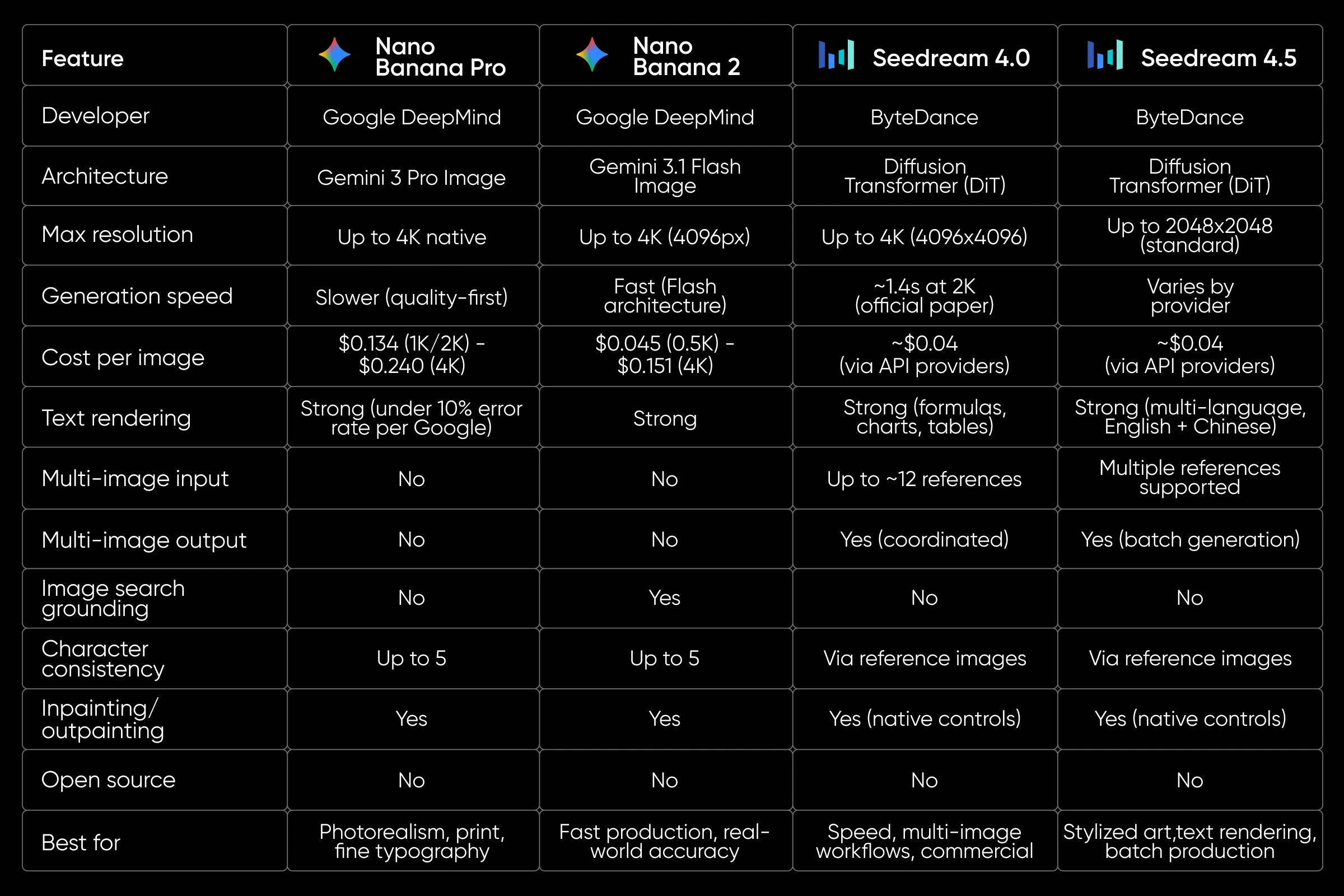
Full comparison table
Here’s how the Nano Banana and Seedream model families compare across every key metric.
Visual showdown – same prompt, four models
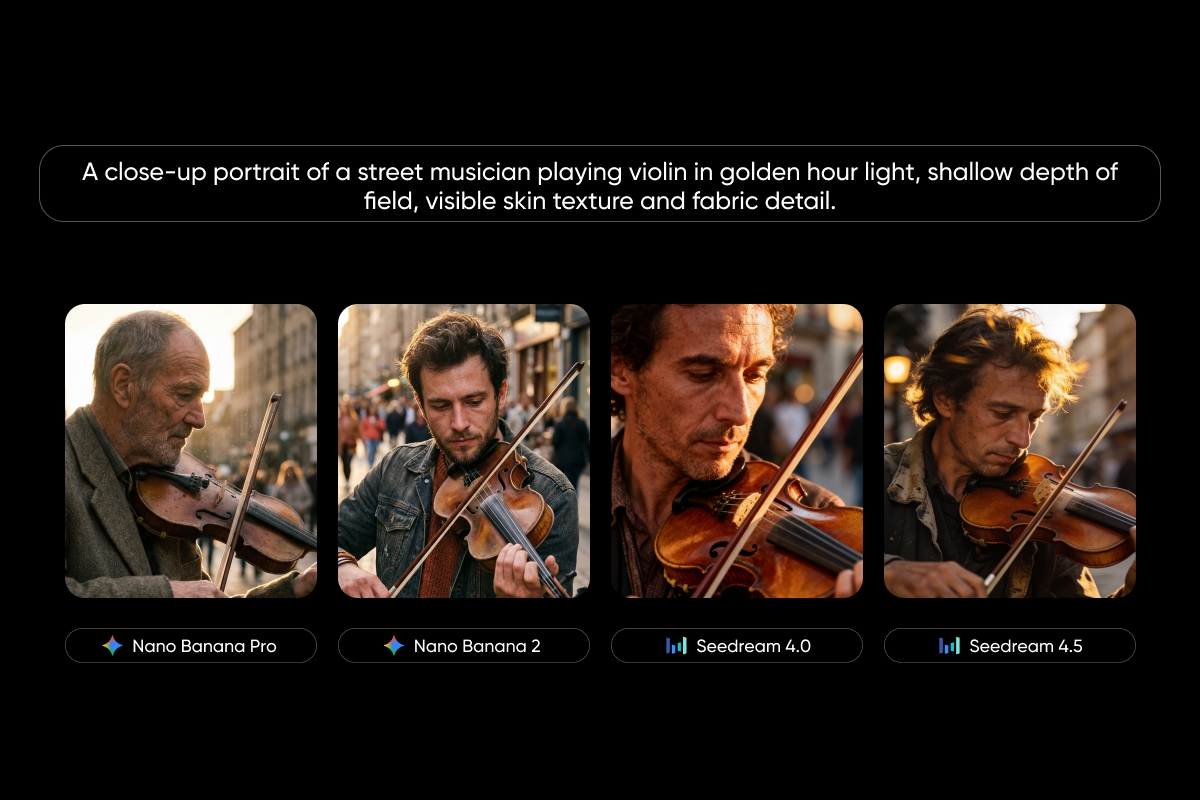
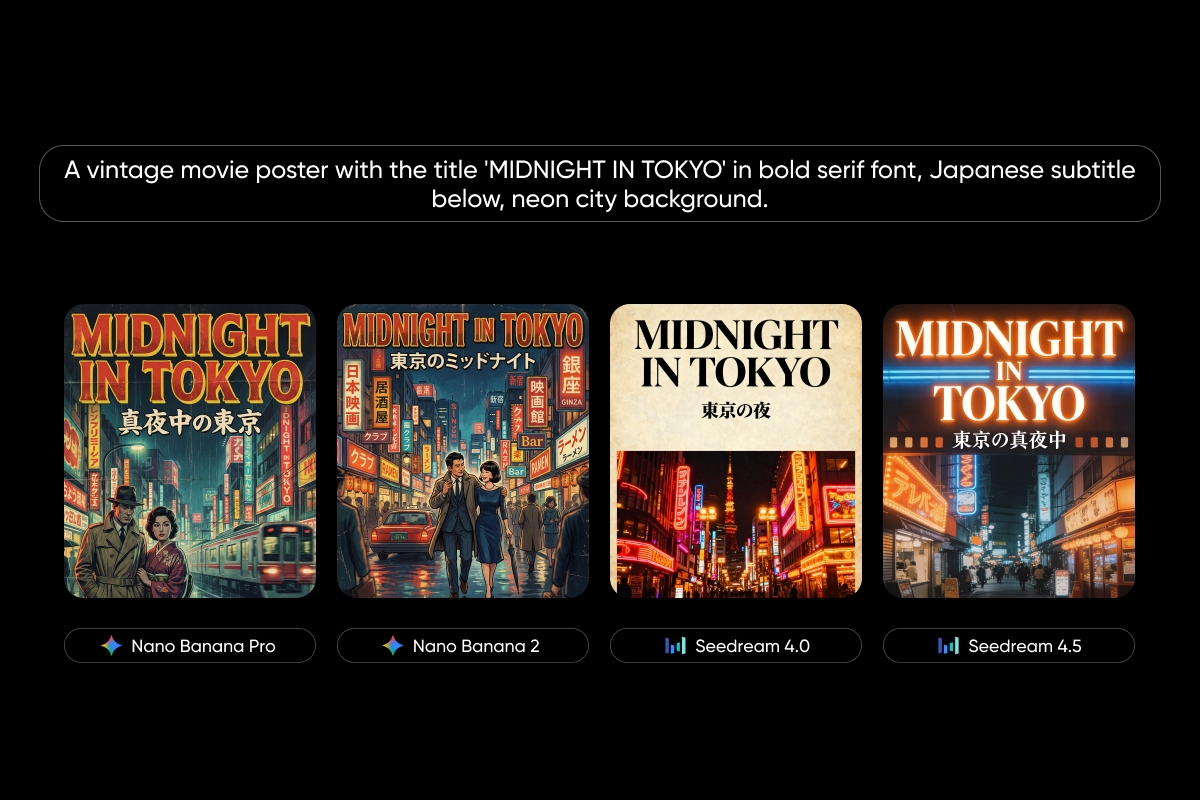
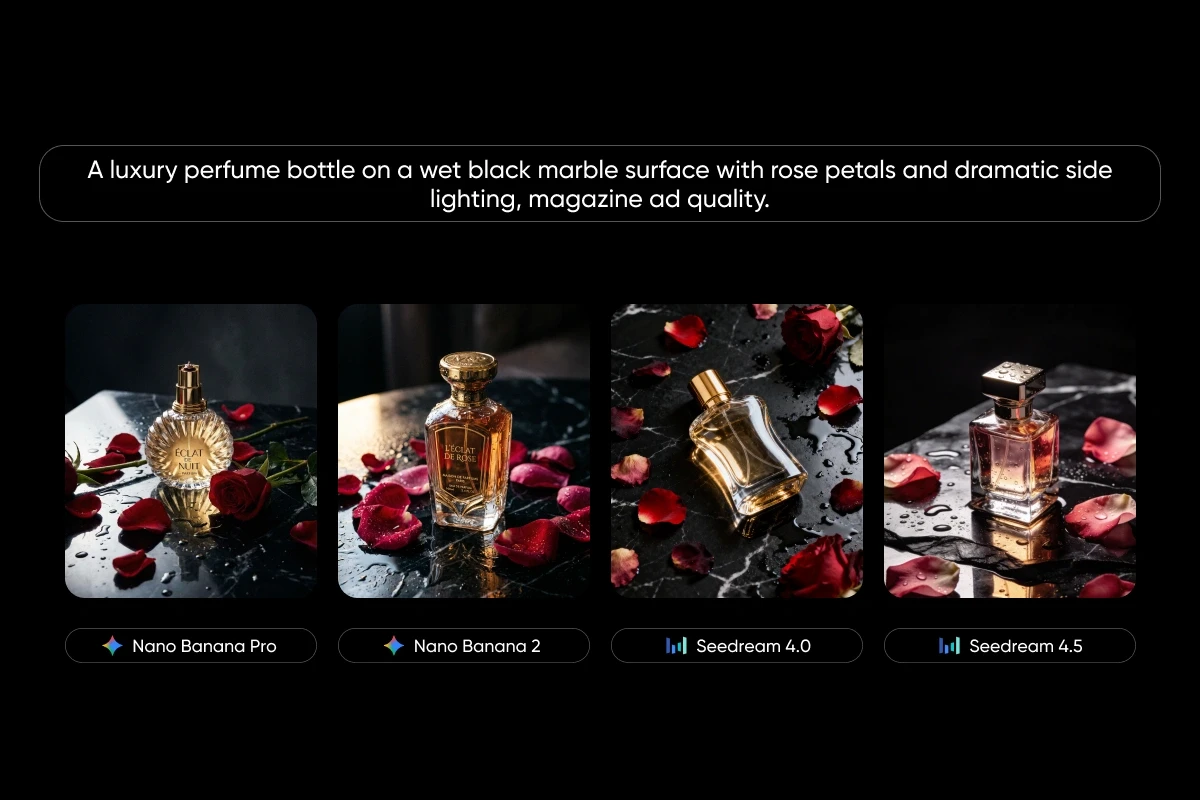
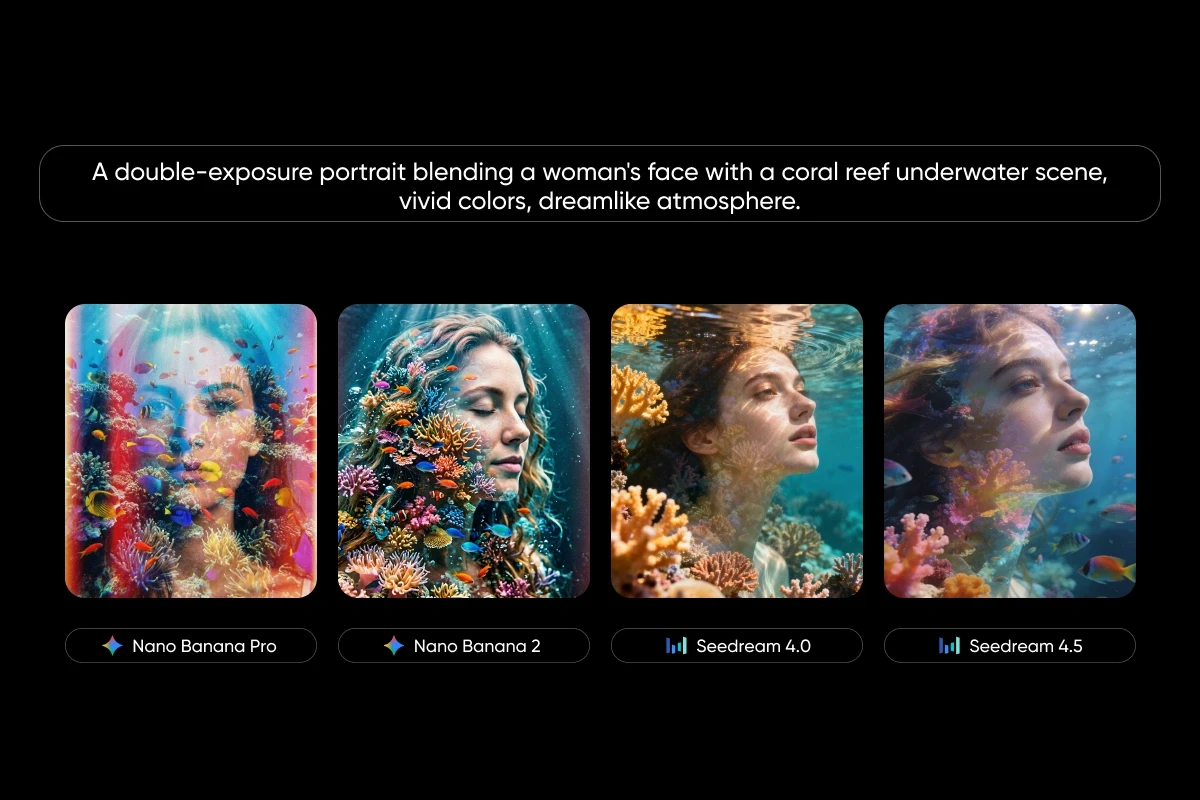
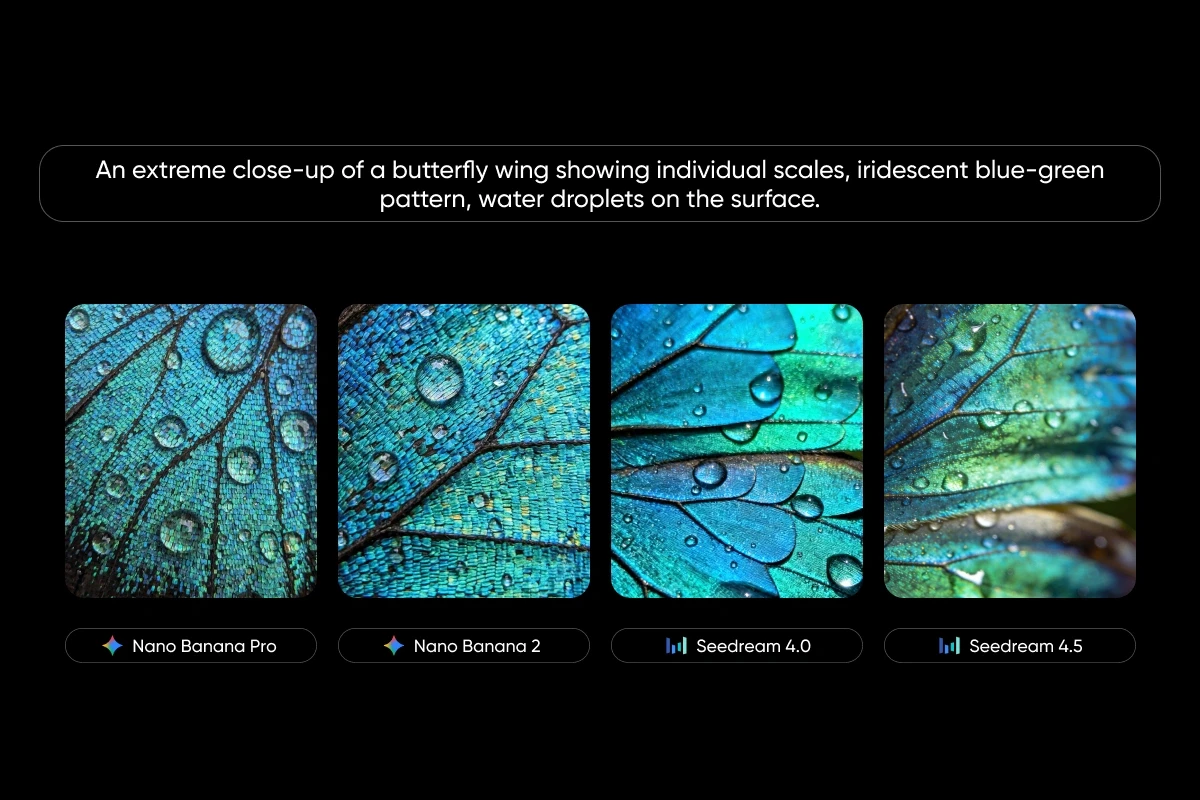
The clearest way to evaluate these models is to run the same prompt through all four and compare the raw output. No editing, no post-processing, default settings across the board.
Photorealistic portrait – “A close-up portrait of a street musician playing violin in golden hour light, shallow depth of field, visible skin texture and fabric detail.”
Text rendering – “A vintage movie poster with the title ‘MIDNIGHT IN TOKYO’ in bold serif font, Japanese subtitle below, neon city background.”
Complex scene – “A crowded rooftop garden party at sunset with at least 6 people, string lights, potted plants, a small dog, and a city skyline in the background.”

Product/commercial – “A luxury perfume bottle on a wet black marble surface with rose petals and dramatic side lighting, magazine ad quality.”
Abstract/artistic – “A double-exposure portrait blending a woman’s face with a coral reef underwater scene, vivid colors, dreamlike atmosphere.”
Fine detail – “An extreme close-up of a butterfly wing showing individual scales, iridescent blue-green pattern, water droplets on the surface.”
Which model should you use?
The right model depends on what you’re creating and what your production workflow looks like.
Choose Nano Banana Pro if photorealism is your top priority. Portraits, product photography, editorial visuals – anything that needs to look like it was captured rather than generated. It’s also the strongest choice for pixel-perfect text in images, whether that’s packaging, signage, or branded materials. Complex compositions with precise spatial requirements and true 4K native resolution without upscaling are where this model earns its premium pricing.
Choose Nano Banana 2 if you need the best speed-to-quality ratio for everyday production. Real-world accuracy is its standout strength – landmarks, buildings, and animal or plant species render with fidelity that other models can’t touch, thanks to Grounding with Google Search (note: this feature does not work for people). It’s also the right pick for a budget-conscious generation at scale, where character and object consistency matter.
Choose Seedream 4.0 if raw speed is critical to your workflow. Generating 2K images in roughly 1.4 seconds per official benchmarks makes it the fastest option in this comparison. Multi-image reference input for consistency, coordinated batch generation, and competitive per-image cost through API providers make it the production speed champion.
Choose Seedream 4.5 if you need stylized, artistic, or commercial-quality visuals. Multi-language text rendering covering both Chinese and English, multi-image campaign consistency through batch generation, and premium quality at a fraction of Nano Banana Pro’s cost make it the go-to for creative teams working at scale.
Quick rule: Nano Banana for photorealism and real-world accuracy. Seedream for stylized creativity and multi-image production. When in doubt, start with Nano Banana 2 or Seedream 4.5 – both deliver premium results at accessible prices.
How to try Nano Banana and Seedream with Picsart
Picsart is one of the few platforms where you can test both model families side by side – no API setup, no keys, no command line.
Picsart AI Playground gives you access to 125+ AI models from 27+ providers, including Nano Banana Pro, Nano Banana 2, and Seedream 4.5. Enter one prompt and compare outputs across models side by side. It’s the fastest way to run your own head-to-head tests before committing to a workflow. Start comparing in the AI Playground.
Picsart Aura is a conversational AI creative assistant. Generate, edit, and refine images through natural chat. Ask for changes, adjust styles, and iterate without re-prompting from scratch.
Picsart Flow is a no-code AI workflow builder where you can chain any model into multi-step pipelines: concept to image to edit to export. Nano Banana 2 is the default image generation model. Build complete creative workflows on Picsart Flow.
Picsart AI Image Generator lets you try Nano Banana and Seedream models directly – no account setup needed. Generate images from text prompts and see results instantly through the AI Image Generator.
Getting started takes four steps:
- Open Picsart AI Image Generator or AI Playground
- Enter your prompt
- Select Nano Banana Pro, Nano Banana 2, or Seedream 4.5
- Compare outputs and choose the best model for your project
Frequently asked questions
Nano Banana is Google DeepMind’s AI image model family, optimized for photorealism, natural lighting, and real-world accuracy. Seedream is ByteDance’s image model family, built on Diffusion Transformer architecture and optimized for stylized visuals, multi-image consistency, and commercial production at lower cost. Both render text in images and support high resolutions, but their creative strengths point in different directions.
Compare both models on one canvas
Two model families, two creative philosophies – and now you know which one fits your workflow. Nano Banana for photorealism that holds up under scrutiny. Seedream for stylized creativity that scales efficiently.
Compare Nano Banana and Seedream side by side in Picsart AI Playground – enter one prompt, see both outputs, and decide for yourself.


