

Contents
Two AI video powerhouses dominate the conversation right now and they approach creativity from completely different angles. In the ongoing Seedance vs Kling debate, the real difference comes down to how you create. Seedance focuses on cinematic storytelling, while Kling prioritizes physical realism and simulation accuracy.
For creators, marketers, and video producers, choosing between these tools directly impacts workflow, output quality, and creative control. This guide breaks down everything that matters: model evolution, Seedance 2 vs Kling 3, feature comparisons, real-world use cases, and a clear decision framework.
By the end, you’ll know exactly which model aligns with your creative process and when it makes sense to use both.
Meet the Seedance and Kling model families
The Kling vs Seedance comparison only makes sense when you understand how each model family evolved. Both platforms have iterated quickly, adding multimodal capabilities, better rendering, and more control, but their core philosophies remain distinct.
Seedance (ByteDance)
Seedance comes from ByteDance’s Seed research team and is available through platforms like Dreamina. From the start, it has leaned into storytelling and creative direction.
Seedance 1.0 introduced strong prompt understanding and multi-shot narrative generation. It could generate a 5-second video at 1080p in about 41 seconds, and ranked first on the Artificial Analysis Arena for both text-to-video and image-to-video at launch. It felt less like generating clips and more like directing scenes.
Seedance 1.5 Pro added native joint audio-video generation, producing synchronized dialogue, sound effects, and music alongside video in a single pass. It introduced precise multilingual lip-syncing (including Chinese dialects like Sichuanese, Cantonese, and Taiwan Mandarin), cinematic camera control with complex movements like dolly zooms and continuous long takes, and enhanced narrative coherence.
Then came Seedance 2.0 in February 2026. This version marked a major leap forward. It supports up to nine image references, three videos, and three audio files simultaneously. Character elements can be created from uploaded video, extracting both visual traits and voice for consistent identity across scenes. The result feels closer to film production than raw generation.
Kling (Kuaishou)
Kling, developed by Kuaishou, took a different route. Instead of focusing on cinematic direction, it built its reputation on realism and control.
Kling 1.0 established a strong baseline for motion realism. Versions 1.5 and 1.6 refined consistency and prompt adherence, while Kling 2.0 expanded into storytelling capabilities. Kling 2.5 Turbo made speed a major advantage. Kling 2.6 introduced native audio generation for the first time in the family.
The real shift came with the Kling 3.0 series in February 2026. This generation introduced multi-shot narratives, element binding for character consistency, native audio in multiple languages with dialect and accent support, and flexible duration up to 15 seconds.
Both ecosystems now support audio-video generation and multimodal input. But the Seedance vs Kling divide still holds: one directs scenes, the other simulates reality.
Seedance 2 vs Kling 3
The comparison between Seedance 2 vs Kling 3 highlights two mature systems built for different creative priorities.
In testing, Seedance 2 tends to produce output that feels more cinematic – lighting looks intentional, skin tones land naturally, and camera movement has a smoothness that mimics real filmmaking. Kling 3 leans more toward grounded realism – materials react to light convincingly, motion feels physically plausible, and complex interactions like splashing liquids or colliding objects hold up well.
Neither model is objectively better in visual quality. They just look different, and which one you prefer depends on whether your project calls for a directed, stylized feel or a grounded, realistic one.
Audio capabilities are where the two models differ most clearly. Both generate native audio alongside video. Seedance 2 produces dual-channel stereo with multi-track output, background music, ambient sound effects, and character voiceover all layered together. Kling 3 supports audio in multiple languages with precise character-level dialogue control, letting you assign specific lines to specific characters in multi-person scenes.
Input flexibility is another key difference. Seedance 2 accepts up to nine images, three video clips, and three audio clips simultaneously, referencing composition, motion, camera style, and sound from your materials. Kling 3.0 Omni also accepts multimodal input combining images, videos, elements, and text, but with fewer simultaneous references.
The bottom line: Seedance 2 feels like working with a director, shaping scenes with atmosphere and consistency. Kling 3 feels like working with a simulator, rendering reality with precision and control. Both produce professional-quality output, but the creative intent behind each is noticeably different.
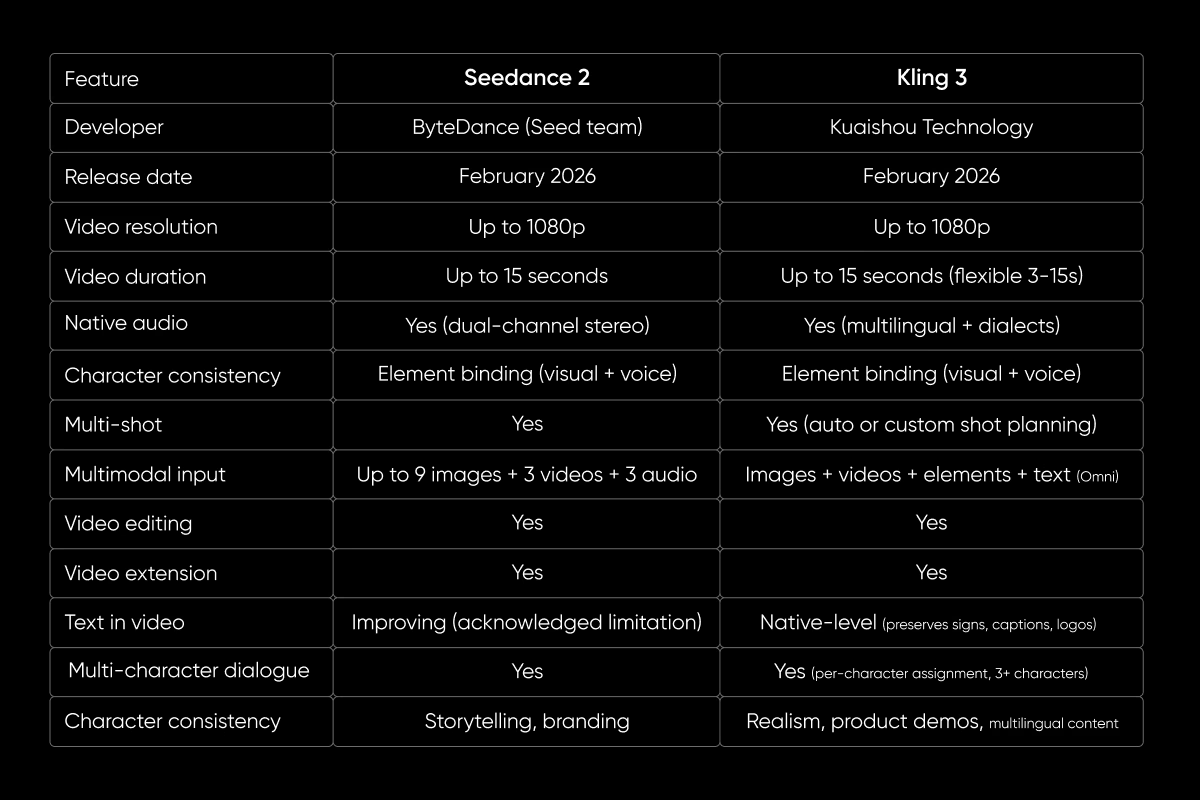
Full comparison table
Here’s how Seedance 2 and Kling 3 stack up across every key metric.
Visual showdown – same prompt, two models
To properly evaluate Seedance 2 vs Kling 3, testing both models with identical prompts reveals the real differences. Using default settings and text-to-video generation, six categories highlight strengths and weaknesses.
Photorealistic portrait
“A close-up of a woman sipping coffee at a Parisian cafe, morning light streaming through the window, shallow depth of field, ambient street noise.”
Text rendering
“A neon sign flickering to life, reading ‘OPEN LATE’ above a rainy Tokyo alleyway at night, puddle reflections.”
Complex action scene
“A skateboarder performing a kickflip over a fire hydrant on a busy city sidewalk, slow motion, pedestrians reacting.”
Product / commercial
“A perfume bottle slowly rotating on a marble pedestal, golden hour lighting, particles of light drifting through the air.”
Abstract / artistic
“An underwater ballet dancer performing in a sunken cathedral, shafts of light piercing through stained glass windows, fish swimming past.”
Fine detail / physics
“A glass of red wine tipping over on a white tablecloth in slow motion, liquid splashing and spreading, droplets suspended mid-air.”
Across these tests, the differences in each model’s approach become clear. The takeaway is not which model is “better,” but which aligns with your creative intent.
Which AI video generator should you use?
Choosing between Seedance vs Kling becomes easier when you match each model to your workflow.
Choose Seedance 2 if you’re creating narrative-driven content like short films or brand storytelling. It works best when consistency matters, characters, styles, and visual themes stay cohesive across multiple shots. The ability to use multiple references (images, video, and audio together) makes it ideal for controlled creative direction. Dual-channel stereo with layered audio tracks adds production value.
Choose Kling 3 if your work involves multilingual content or precise character control. Native audio in multiple languages with dialect support and per-character dialogue assignment makes it strong for international content. Multi-shot narratives with automatic shot planning, native text rendering, and flexible duration up to 15 seconds give it an edge for structured production.
Choose both if you’re exploring AI video seriously. Running the same prompt through both models reveals strengths you wouldn’t notice otherwise.
A simple rule captures the Seedance 2 vs Kling 3 decision: Seedance directs. Kling simulates.
How to try Seedance and Kling with Picsart
Testing both models doesn’t require switching platforms or workflows. Picsart brings them together in one place, making comparison seamless.
Picsart AI Playground gives access to over 129 AI models, including both Seedance and Kling. You can input a single prompt and instantly compare outputs side by side. This removes guesswork and helps you quickly identify which model suits your project.
Picsart AI Video Generator supports both text-to-video and image-to-video workflows. You can choose your model directly and refine outputs without jumping between tools.
For more advanced workflows, Picsart Flow allows you to chain steps together: generate a concept, turn it into video, edit it, and export, all within a single pipeline.
Getting started with Seedance and Kling on Picsart
1. Open AI Playground or AI Video Generator
Head to Picsart AI Playground to compare multiple models side by side, or jump straight into the AI Video Generator for a focused text-to-video or image-to-video flow. Both routes give you access to Seedance and Kling without switching tools.
2. Enter your prompt
Write a descriptive prompt covering subject, setting, camera movement, lighting, and mood. The more specific your direction, the more both models have to work with, and the more meaningful your comparison becomes.
3. Select Seedance or Kling
Pick Seedance 2 when you want cinematic storytelling, layered audio, and consistent characters across shots. Pick Kling 3 when you need grounded realism, multilingual dialogue, or native text rendering. In AI Playground, you can run the same prompt through both at once.
4. Compare outputs and refine
Watch the clips side by side and note which model handled motion, lighting, sound, and detail the way you wanted. Tweak your prompt, re-run on the winning model, and iterate until the output matches your creative intent.
Conclusion
Two cutting-edge tools, two distinct creative approaches. The Seedance vs Kling comparison ultimately comes down to what you value more: cinematic direction or physical realism.
Seedance 2 brings storytelling to life. Kling 3 brings realism to the forefront. The smartest move is to test both.
Try them side by side on Picsart AI Playground, compare outputs, and see which one matches your creative instinct.
Frequently asked questions
Seedance accepts the broadest multimodal input (up to 9 images, 3 videos, 3 audio clips) with character locking and dual-channel stereo audio. Kling offers multilingual audio with per-character dialogue control, automatic multi-shot planning, and native text rendering in video.


