
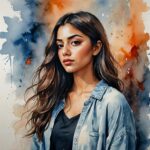

Qwen Image 3.0 Pro is available now in the Picsart AI Playground and the AI image generator. It is Alibaba’s flagship image model, a generation on from Qwen 2, and it does two jobs: it makes images from a text prompt, and it changes images you already have.
The thing worth knowing before you start is that it has no low quality setting. Every resolution it offers runs at roughly 4.2 megapixels, from a 2048 by 2048 square up to wider landscape and portrait shapes. Most models ask you to trade resolution for speed. This one does not offer the trade.
That design points at what it is for. Fine detail survives at this size, which matters most when your image contains things that fall apart at lower resolutions: text on a sign, panels in a storyboard, items on a menu, small elements inside a busy layout.
Here is what the model gives you and how to get the most out of it.
What Qwen Image 3.0 Pro does
Three things, all from the same model.
It generates from text. Describe what you want and the model builds it. The output is aimed at work that gets published rather than work that gets posted, so think brand imagery, ad creative, and anything where a client will look closely.
It also has unusual room for instruction. Prompts run to around 4,500 tokens, which is thousands of words of direction. Short prompts work, but you are leaning on the model to guess rather than telling it what you want.
It edits what you already have. Hand it an image, say what should change in ordinary language, and it makes the change. You stay in one model for the whole job, so a revision never means rebuilding your look somewhere else.
It gives you several options at once. Ask for one, two, four, or six versions of the same prompt. Six is the fastest way to learn whether an idea is working, because you see the range the model is capable of before you commit to refining any single result.
Prompt-rewrite and thinking modes
Two things happen between your prompt and your image, and together they are most of what separates this generation from the last one.
Prompt-rewrite takes a thin prompt and fills it out before anything is generated. It can do that on its own or hand the job to an agent. If you write three lines and get back a fully realised scene, this is the part responsible.
Thinking mode gives the model a chance to work through a complicated brief first. A prompt carrying several subjects, a fixed layout, and text in three separate places is exactly the sort of request that collapses without it.
Neither does much for a simple prompt. There is little to expand and little to work out. On a demanding one, they are the difference between a near miss and the thing you asked for.
Everything happens in one bar at the bottom of the Playground. If you want to see what else is available first, the full model catalog is one click away, and the AI image generator runs the same model.
How to use Qwen Image 3.0 Pro
1. Open the Playground and choose Image
The switcher on the left moves between video, image, and music.
2. Select Qwen Image 3.0 Pro
It shows up in the model dropdown as Qwen 3.0 Pro.
3. Pick your resolution
Five options, from a 2048 by 2048 square to wider landscape and portrait shapes.
4. Set how many images you want
One, two, four, or six per run.
5. Write your prompt
Type it, or press the microphone and say it. If you are short of ideas, Inspire me will fill the box for you.
6. Add a reference image
Only if you are editing rather than generating from scratch.
7. Generate
Pick the strongest result, or run it again with a tighter prompt.
Where you can use it
The Playground is the easiest place to start, mostly because you can run the same prompt through Qwen Image 3.0 Pro and 170+ other models and see the difference side by side. Nothing needs configuring first.
It also travels. Use it on the web, in the Picsart desktop app, or wire it into your own projects through the CLI, MCP, REST API, and SDK. You will not need an API key from anyone else or a second subscription.
Credits are shared across the whole catalog too. Moving between this and Qwen 2 Pro, Seedream 4.5, Flux 2 Pro, or Imagen 4.0 Ultra costs you a dropdown, not a new tool.
Choosing your resolution
Five presets, three shapes.
| Resolution | Shape | Ratio | Use it for |
|---|---|---|---|
| 2048 x 2048 | Square | 1:1 | Feed posts, profile art, product tiles |
| 2688 x 1536 | Wide landscape | 1.75:1 | Banners, headers, cinematic scenes |
| 1536 x 2688 | Tall portrait | 1:1.75 | Stories, Reels covers |
| 2368 x 1728 | Landscape | 1.37:1 | Editorial spreads, print layouts |
| 1728 x 2368 | Portrait | 1:1.37 | Menus, posters, book covers |
The two landscape options differ more than the numbers suggest. 2688 x 1536 is the wider, more cinematic crop. 2368 x 1728 sits closer to a classic photo shape and leaves more vertical room, which helps when your subject is tall or your layout needs headroom.
One practical note on vertical. 1536 x 2688 is the closest thing to a 9:16 social frame, but it is not exactly on it, so plan for a small crop if you are posting straight to Stories or Reels. 1728 x 2368 is a gentler portrait and suits print style layouts better than social.
Text that survives the render
Ask most image models for a poster with a headline on it and you get a poster with something headline shaped on it. The letters are almost right. Nothing is spelled correctly. You either prompt again or open a design tool and place the type yourself.
This model was built to avoid that. It holds type down to around 10 pixels, and it spells things properly, which is what makes packaging, menus, ad creative, and interface mockups possible as single generations rather than as generation plus cleanup.
The two modes above are doing quiet work here. Long briefs are where text usually wanders off, and reasoning through the layout first is what keeps a caption attached to the thing it was captioning.
There are 12 languages and more than 20 typefaces available natively, which matters if one campaign has to ship in five markets, or if the font itself is part of how the brand is recognised.
When words are load bearing rather than decorative, that reliability is the whole difference between an asset you can use and an afternoon of edits.
Editing an existing image
Attach your image, then write the instruction. Two habits make the difference here.
Say what should stay, not just what should change. Editing models drift on the parts you leave unmentioned, so if the face, the hair, or the product needs to survive the edit, put that in the prompt explicitly.
Then describe the target, not the delta. “A champagne silk blouse under a tailored grey blazer” gives the model more to work with than “make the top nicer.” Detail on the destination beats instructions about the journey.
Because generating and editing live in the same place, a second pass does not cost you the look you established in the first.
What it is built for
Any model can produce a nice looking picture. This one is aimed at a harder job: pictures that have to carry information as well as look good.
Busy layouts, one generation. It can place images inside images, so a composition with many parts arrives assembled rather than needing to be built. Storyboards, menus, magazine spreads, and newspaper pages are all within reach.
Screens and interfaces. It can imitate web pages, games, and live stream layouts convincingly enough for app screens, product UI, and stream overlays, which saves opening a design tool to fake them.
Detail that holds up close. Expression, skin texture, individual hairs. This is usually where generated people give themselves away, with skin sanded smooth and hair rendered as a single object.
If you want something simple and you want it now, a lighter model will be quicker. Reach for this one when somebody is going to look closely.
Try Qwen Image 3.0 Pro
Open the Picsart AI Playground, pick Qwen Image 3.0 Pro, and give it something with detail in it.
Get answers to common questions
It is the top tier of Alibaba’s Qwen image family, available in the Picsart AI Playground and AI image generator. It generates images from text, edits images you supply, expands and reasons through prompts before generating, and can return up to six results at once.


